
The Bull Who Stands Still

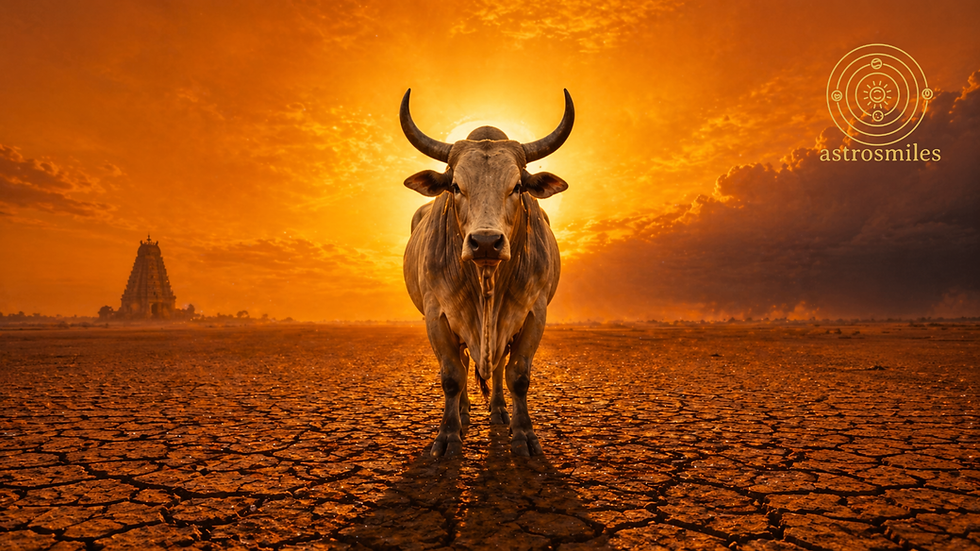
There is a creature that has walked beside humanity longer than almost any other — not as a pet, not as entertainment, but as a partner in building civilization itself. The bull.
Not the raging, snorting animal of the arena. That is a story others tell. The real bull — the one who has shaped economies, inspired gods, and anchored families for millennia — is something far more interesting.
He is still. He is patient. And he does not move until he is ready.
How a Bull Actually Behaves
Forget the matador's ring. Watch a bull in a field.
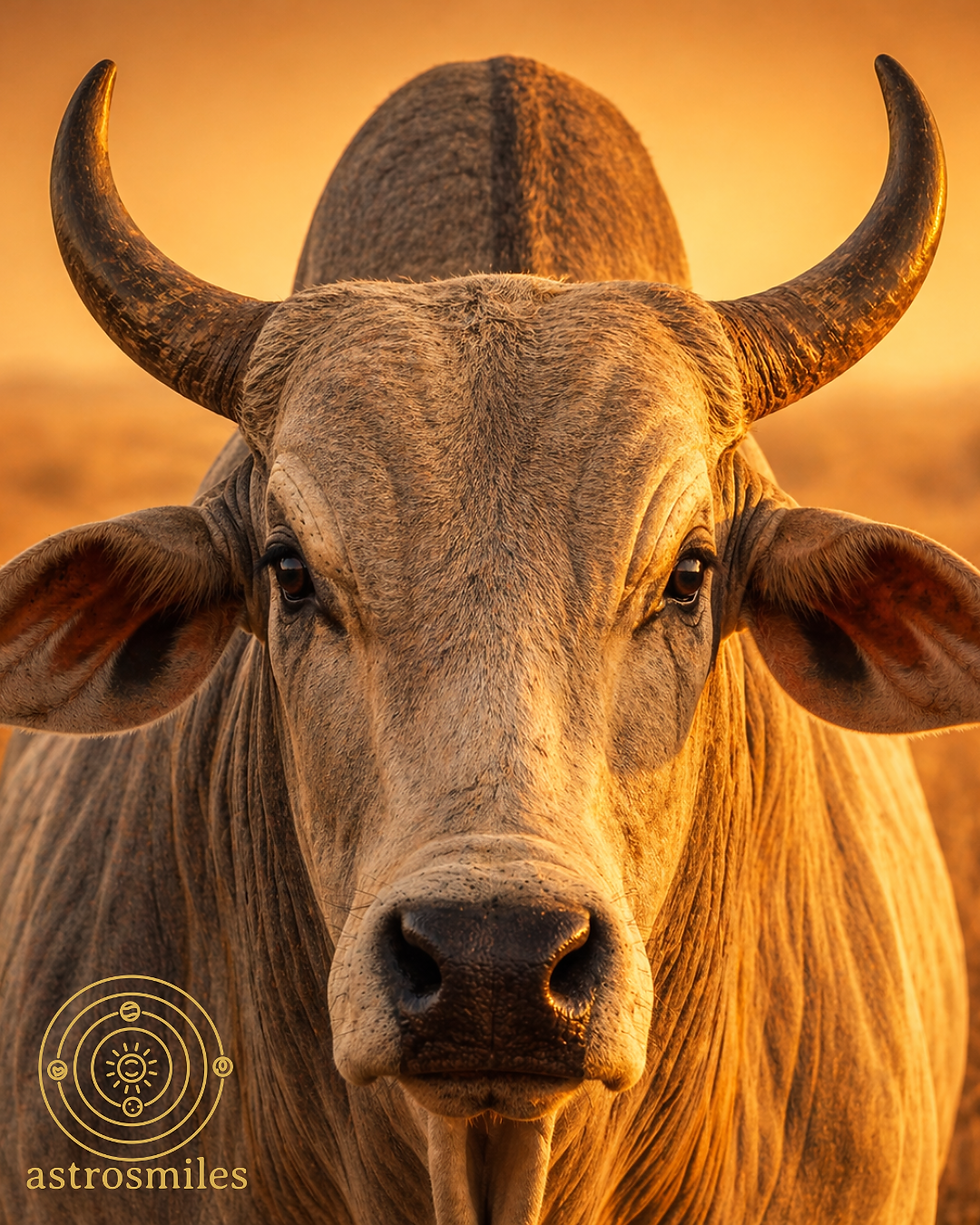
He grazes slowly. One bite per second when he is feeding — steady, rhythmic, unhurried. He does not rush. He does not chase. He eats when it is time to eat. He rests when it is time to rest. His day is structured not by anxiety but by rhythm.
A bull is most active in the early morning hours — cortisol peaks at the onset of daylight, energy is highest between dawn and late morning. By evening, his system quiets. He settles. There is something deeply instructive here: the bull does not burn the midnight oil. He rises with the sun, does his work in the hours of light, and rests when darkness arrives. His energy follows the rhythm of the earth itself.
A bull is profoundly territorial — but not in the way we imagine. He does not attack for sport. He does not seek conflict. He stands. He positions himself sideways to show his full size — not as aggression, but as a statement: I am here. This is mine. Move along.
Only when that boundary is ignored does the head lower, the shoulders round forward, the hoof paw the ground. Even the warning is measured. He gives you time to leave.
And here is something worth knowing: it is not the colour red that enrages a bull. Bulls are dichromatic — they cannot even see red. They see the world in shades of yellowish-green and bluish-purple. What provokes a bull is not colour. It is movement. The waving of the cape, the invasion of space, the disruption of stillness. The bull responds not to what something looks like, but to what it does. Threaten his space, disrupt his rhythm, invade his territory — and he will move. But the colour of your shirt? He could not care less.
When a bull protects his herd, he does not scatter in panic. He places himself between the threat and his family. He faces it. Quietly. The calmer the bull, research tells us, the stronger his growth, the healthier his offspring. Aggression is not strength. Stillness is.
The Bull with a Partner
When it is time for courtship, the bull is not hasty. He approaches. He sniffs. He nuzzles. He waits. He assesses the cow's readiness through scent and proximity — not through force. If she is not receptive, he does not persist aggressively. He stays close. He is patient. He follows gently.
When she is ready, there is no drama. No performance. The dominant bull — the one who has earned his place through presence, not through constant fighting — mates with a quiet authority. Estrous females have even been observed seeking out the dominant bull, coming to him rather than being chased.
The courtship of the bull is not romance as we imagine it. It is something older: attentiveness, patience, the willingness to wait until the timing is right. Not forcing the moment. Letting it arrive.
What Irritates the Bull
The bull does not anger easily. But when he does, it is instructive to notice what triggers it.
Not colour. Not noise, particularly. What irritates a bull is the invasion of his space. Sudden movements in his territory. Unfamiliar presences near his herd. The disruption of established patterns. A bull raised in isolation — without social contact — becomes far more aggressive than one raised within a group. It is disconnection, not strength, that produces rage.
In other words: the bull becomes dangerous when his world is destabilised. When boundaries are crossed. When rhythm is broken. When what he has carefully built — his territory, his herd, his routine — is threatened without warning.
There is a life lesson here that barely needs translating.
The Bull's Day: A Pattern Worth Noticing
The bull's daily rhythm is not random. It maps remarkably well onto the Vedic concept of the muhurtas — the divisions of the day that govern when certain activities are most auspicious.
The bull grazes most intensely in the early morning and again in the late afternoon, with a period of rest and rumination in between. He chews his cud — a process of digesting what he has already consumed, extracting more nourishment from the same material. He does not constantly seek new food. He takes what he has and processes it more deeply.
His cortisol — the hormone that governs alertness and energy — peaks at dawn. By nightfall, it drops to its lowest. The bull's body is telling him what the ancient sages told us: the morning hours are for action. The evening is for rest. And the hours in between are for digestion — of food, of experience, of life.
This is Taurus energy distilled into biology. Not the frantic productivity of fire signs. Not the restless curiosity of air. The slow, steady rhythm of earth: gather, process, rest, repeat.
The Bull's Season: Grishma — The Fire That Forges
In Western tropical astrology, Taurus is associated with spring — gentle pastures, mild weather, new growth. But in Vedic astrology, which follows the sidereal zodiac, the Sun enters Vrishabha around May 15 and remains until June 14. This is not spring. This is the onset of Grishma Ritu — the Hindu summer season, the hottest, most unforgiving period of the Indian year.
This changes everything about how we understand the bull.
Grishma is not gentle. The earth cracks. The rivers thin. The pastures dry. The sun is relentless. This is the season when survival depends not on abundance but on endurance — on what you have stored, on the reserves you built when times were easier, on your capacity to stand firm when everything around you is being tested by fire.
And this is precisely what the bull does.
In extreme heat, a bull does not panic. He does not flee. He seeks shade — often beneath trees, which research shows is more effective than artificial shelter. He reduces his grazing during the hottest daylight hours and shifts his feeding to early morning and late evening. He stands near water. He conserves energy. He waits.
Indian cattle — the Zebu breeds, the descendants of the ancient Bos indicus — are built for this. They carry roughly 1,600 sweat glands per square centimetre of skin, compared to just 250 in European breeds. Their short, light-coloured coats reflect radiative heat. Their dark skin pigmentation protects against ultraviolet damage. They are not cattle that need mild weather to thrive. They are cattle that were forged by heat itself.
This is the bull of the Vedic zodiac. Not the pastoral, spring-grazing bull of the Western imagination. The bull who endures. The bull who has been tested by fire and emerged not weakened, but tempered.
And here the connection to the Sanskrit concept of tapas becomes unavoidable. Tapas — from the root tap, meaning "to heat" or "to burn" — is the Vedic concept of transformative fire. It is the discipline of enduring difficulty not to suffer, but to be purified. The Rig Veda tells us that the rishis themselves were tapas-born — brought into being through the creative heat of sustained spiritual effort. The Atharva Veda says that all earthly life was created from the sun's tapas.
Grishma Ritu is tapas made weather. And the bull — Vrishabha — is the creature who stands in the middle of it and does not break.
This is the deeper teaching. The 2nd house — the bull's house — is not merely about accumulating wealth in easy times. It is about having built enough reserves, enough stability, enough inner substance that when the fire comes — and the fire always comes — you can stand in it. Not because you enjoy suffering. Because you have stored what matters. Because your ground is solid. Because, like the Indian bull in the blazing heat of Jyeshtha, you know how to conserve, how to wait, and how to endure until the season turns.
The Taurus constellation itself is one of the oldest known to humanity, dating back to the Early Bronze Age. The Egyptians saw it as a sacred bull associated with the renewal of life. But in the Vedic framework, this renewal does not come from gentle spring rain. It comes from what survives the fire. The monsoon — Varsha Ritu — follows Grishma. The rains come after the heat. Abundance is the reward for endurance, not a birthright.
The Bull in the World Around You
You already speak the bull's language — you just may not have noticed.
When you say someone should take the bull by the horns, you are invoking the oldest image of courage: not running from what is difficult, but grabbing it directly and facing it down.
When you hear about a bull market, you are hearing about a time when value rises — not through panic or speculation, but through sustained confidence, the slow upward push of optimism and patience. The bull does not crash upward. He climbs.
And that bull market has a physical monument. In 1989, after the catastrophic Black Monday crash of 1987, an Italian-American sculptor named Arturo Di Modica spent $360,000 of his own money to create a 7,100-pound bronze bull. He placed it, without permission, in front of the New York Stock Exchange on a December night — beneath a Christmas tree. His message: the American economy would recover. Not through panic, but through the qualities the bull embodies — strength, patience, and the refusal to stay down. The city removed it. The public outcry was so great they put it back. It has stood in Bowling Green Park ever since — the most photographed symbol of financial resilience in the world.
When you call someone bull-headed, you describe the quality that frustrates others but often gets results — the refusal to be moved from a position, the insistence that what matters to you will not be surrendered easily.

Even the bull's-eye — the perfect centre of a target — carries this energy. Not flashy. Not approximate. Exactly right. The bull does not scatter. He lands precisely where he intends.
And then there are the words we rarely think about: capital — the foundation of every economy — comes from the Latin caput, meaning "head." It originally referred to head of cattle. And pecuniary, meaning relating to money? From pecus — cattle. The bull is not a metaphor for wealth. The bull is the origin of the concept of wealth.
The Bull in Brands You Know
The bull's energy is everywhere in the modern world, hiding in plain sight:
Lamborghini — Ferruccio Lamborghini was born under Taurus. He loved bullfighting. He named his cars after famous fighting bulls — Miura, Diablo, Aventador. The raging bull on every Lamborghini is not just a logo. It is a birth chart made metal.
Red Bull — Two red bulls charging headfirst into each other against a golden sun. The logo was adopted from Krating Daeng, a Thai energy drink whose name literally translates to "red bull." The symbolism is primal: raw energy, vitality, the refusal to back down.
Merrill Lynch — The thundering herd. A bull in full charge. The financial firm chose the bull not for aggression but for what the bull market represents: rising prosperity, forward momentum, the confidence to invest.
The Chicago Bulls — One of the most recognisable sports logos in the world. The red-faced bull with blood-tipped horns. Designed as a favour for free basketball tickets. Now a global symbol of competitive intensity and relentless drive.
The bull is not just an ancient symbol. He is alive in the brands, the language, and the markets that shape modern life.
The Bull's Jobs: What He Has Always Done
For at least six thousand years, the bull — or more precisely, the ox, his trained and steadied counterpart — has been humanity's partner in the most fundamental work of civilisation.
Ploughing — The ox was the tractor of the ancient world. He broke the heavy, clay-filled soil that human hands could not turn. Without him, the great agricultural civilisations — Egypt, Mesopotamia, India, China — could not have fed their populations. The ox could pull heavier loads than horses for millennia, because the yoke was designed for his anatomy — his powerful neck and shoulders — in a way that it never fitted the horse. It was not until the invention of the horse collar that horses could even compete.
Transport — Ox-carts were the trucks and trains of the pre-industrial world. Goods, timber, stone, and grain moved on the backs and behind the shoulders of cattle.
Milling and irrigation — Oxen powered the grinding mills and water wheels that turned grain into flour and brought water from rivers to fields.
And today? There are still 300 to 400 million working oxen on the planet. In small farms across India, Southeast Asia, Africa, and South America, the bull still does what machines cannot do cheaply: the slow, patient, essential work of feeding the world.
The Sacred Bull: Nandi, Apis, and the Horns That Reach Upward
Now let us go deeper. Because the bull has not merely shaped human language and commerce. He has shaped human worship.
Nandi — The One Who Waits
In every Shiva temple in India, before you reach the sanctum, you must pass Nandi. The great bull. Seated. Facing Shiva. Unmoving.
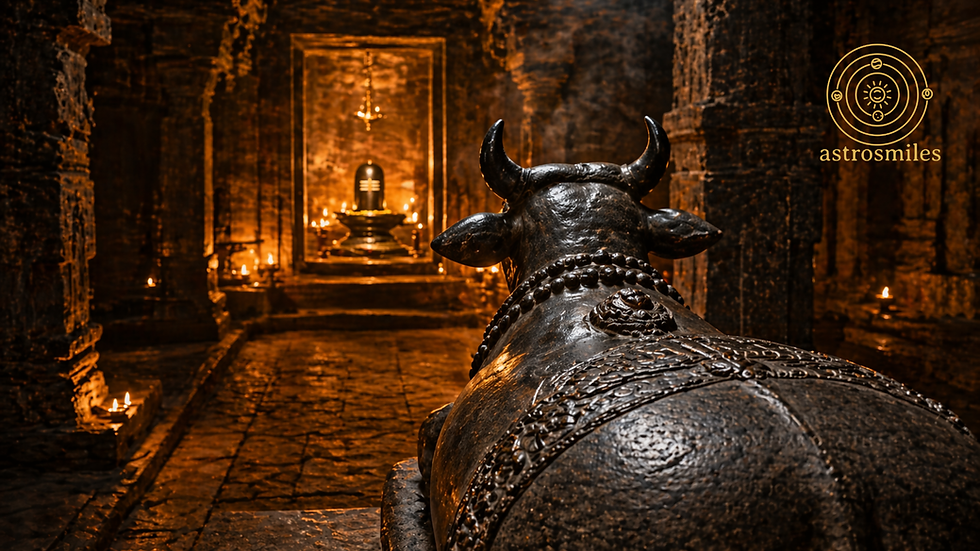
The Sanskrit word Nandi means joy, happiness, satisfaction. Not the joy of acquisition — the joy of devotion. Nandi does not fidget, does not look away, does not wander off to graze. He faces what is sacred and he does not move.
This is not obedience. This is mastery. Nandi is called the gatekeeper of Shiva — meaning nothing reaches the divine without passing through the quality he represents: patience, stillness, the willingness to wait.
And the bull itself — Vrishabha in Sanskrit — is a word that carries the weight of dharma. Vrishabha is not just a bull. Vrishabha is the embodiment of righteousness, of moral order, of the cosmic principle that holds everything in place. When the ancient texts say that dharma stands on four legs, those are the legs of the bull.
So when you see Nandi sitting in perfect composure outside a temple, you are not seeing an animal. You are seeing a teaching: what is unshakeable within you is what gives you access to the divine.
Apis — The Living God of Egypt
In Memphis, three thousand years ago, the Egyptians did not merely worship the bull. They believed the Apis bull was a god walking among them — the living embodiment of Ptah, the creator, and later associated with Osiris, the lord of the afterlife.
Each Apis bull was identified by sacred markings — a white triangle on the forehead, a scarab shape on the tongue, specific patterns on the body. When one Apis died, the entire kingdom mourned. The bull was mummified. Buried in a granite sarcophagus. Given the funeral of a pharaoh.
What were they seeing? Not just an animal. They were seeing what the bull represented: fertility, abundance, cosmic order, the generative power that makes everything grow. The bull was the bridge between earth and heaven.
Crete — The Leap of Faith
On the island of Crete, the Minoans painted their walls with images of young men and women leaping over charging bulls. Not killing them. Not running from them. Dancing with them.
Bull-leaping was a sacred act — an encounter with raw power that demanded grace, timing, and absolute trust in your own body. You did not fight the bull. You moved with it.
There is a teaching in this too: sometimes the most powerful thing you can do with overwhelming force is not resist it, but learn to move in rhythm with it.
The 2nd House: Where the Bull Lives in Your Chart
In Vedic astrology, we speak of twelve houses — twelve domains of life, each governing a different dimension of your experience. The second house — Dhana Bhava, the house of wealth — is the natural home of Taurus. The bull's house.
But wealth, in the Vedic framework, is not merely money.
The 2nd house governs what you hold — and that holding operates on every level.
It is your accumulated wealth — not what you earn (that is the 11th house), but what you keep. Your savings. Your reserves. Your capacity to store and sustain. Just as the bull grazes steadily and builds body mass over time — not in bursts, but in rhythm — the 2nd house is about what you accumulate through patience, not what you chase through ambition.
It is your family — the people you were born into, the values they gave you, the traditions they passed down. The 2nd house is generational wealth in its deepest sense: not just money, but culture, identity, belonging. Think of the bull's herd — the group he protects, positions himself around, never abandons.
It is your speech — the words you choose, the voice you carry, the way your mouth shapes language. The 2nd house rules the throat, the jaw, the teeth, the tongue. How you speak is, in the Vedic view, a direct expression of what you value. And remember: the bull communicates not through constant noise, but through selective, purposeful vocalisation. He bellows when it matters. He is silent when it does not.
It is your food — what you put into your body, how you nourish yourself, what sustains you physically. The bull's entire daily rhythm is organised around eating, digesting, and resting. His relationship with food is not casual. It is central. It is life.
And it is your values — the invisible architecture that determines every choice you make. What do you hold precious? What will you not sell? What do you refuse to compromise? This is the bull's territory — not a physical field, but the ground of principle on which he stands.
This is the bull's domain. Not flashy. Not dramatic. But foundational. Without the 2nd house, nothing else in the chart has ground to stand on.
When the 2nd house is strong — when its ruler (Venus and Moon) is well-placed — the person is like a well-fed bull on solid ground — one who has stored enough to endure any season. Stable. Nourishing. Generous. Their speech is measured and powerful. Their family bonds are deep. Their resources grow steadily.
When the 2nd house is afflicted, the ground shakes. Financial instability. Harsh or stammering speech. Family conflict. A feeling of never having enough — not because there is not enough, but because the capacity to hold has been compromised. Like a bull removed from his herd, raised in isolation — the natural stability turns to agitation.
Taurus Across the Twelve Houses: The Bull in Every Room of Your Life
Now here is where it becomes personal. In the natural zodiac, Taurus — Vrishabha — rules the 2nd house. But in your actual birth chart, Taurus can fall in any of the twelve houses, depending on your rising sign.
Wherever Taurus sits in your chart, that is the area of life where the bull's qualities show up most strongly: patience, stubbornness, beauty, resource-building, sensuality, and the refusal to be rushed.
Think of it this way. There are twelve rooms in the house of your life. In one of those rooms, there is a bull standing quietly. That room is where you are most methodical, most resistant to change, most capable of building something that lasts — and most likely to dig your heels in when pushed.
And here is the key insight: the bull's real-world behaviour maps directly onto each house placement.
1st House — The Self The bull standing in the open field. You move through the world slowly and deliberately. People experience you as calm, grounded, and immovable. You project quiet strength. You do not like to be rushed. Your first instinct in any new situation is to observe, assess, and then — only then — respond. You have a healing, steadying effect on others simply by being present. Like the bull who shows his full size not as a threat but as a fact — you do not need to prove your strength. It is visible.
2nd House — Wealth and Values The bull on his home pasture. Taurus is at home here. You are a natural accumulator — of money, of possessions, of the things that make life beautiful and secure. Your voice carries weight. Your relationship with food, comfort, and material security is central to your well-being. You build wealth the way the bull builds body mass — slowly, steadily, through daily rhythm, never gambling with what you have built.
3rd House — Communication and Courage The bull who bellows only when it matters. Your communication style is deliberate. You do not speak quickly, but when you do, your words carry weight. You are a practical thinker — not interested in abstract theory, but in ideas that have real-world application. Like the bull who vocalises selectively and purposefully, your speech is economic. You say what needs to be said. Nothing more.
4th House — Home and Heart The bull protecting his herd. Your home is your sanctuary — and you invest heavily in making it beautiful. Much of your financial energy flows toward creating a living space that feels luxurious, secure, and deeply personal. You are the nurturer of the family, providing not just materially but emotionally, with a steady and unwavering presence. Like the bull who positions himself between threat and family — your instinct is to shield what you love.
5th House — Creativity and Children The bull in courtship — patient, attentive, sensual. You are sensual and romantic in love — steady, loyal, and deeply affectionate. Just as the bull courts through nuzzling and patience rather than force, your approach to romance is attentive, not aggressive. With children, you are consistent and generous, wanting them to have the good things of life. You take enormous pride in what you create and in those you nurture.
6th House — Health and Service The working ox — steady, productive, purposeful. You work hard, but you need to see the tangible results of your effort. Like the ox who has powered civilisation's most essential work for six thousand years — ploughing, milling, transporting — you are drawn to work that is practical and produces something real. Health issues, if they arise, tend to involve the throat and neck. Your approach to daily life is methodical and grounded.
7th House — Partnership The dominant bull chosen by his mate. You are drawn to partners who are stable, reliable, and often prosperous. You invest deeply in your relationships — emotionally and materially — and you take pride in how your partner presents to the world. Like the bull whose mate seeks him out because of his steady dominance rather than flashy aggression — you attract through reliability, not drama.
8th House — Transformation and the Hidden The bull who endures all seasons. You have a quiet power to generate resources from unexpected sources. Transformations in your life happen slowly, not suddenly — like the bull who adapts to changing weather not through dramatic action but through constitutional resilience. There may be inheritance or wealth that comes through others. Your relationship with the mysterious is steady, not dramatic.
9th House — Beliefs and Higher Learning The bull who does not change pastures easily. Your philosophy is practical and grounded. You do not change your beliefs easily — once you have found a worldview that works, you hold to it with the stubbornness of a bull who has found good grazing ground. You insist on fairness and justice, especially in matters of money and relationships. Spiritual growth, for you, comes through experience, not theory.
10th House — Career and Legacy The bull on Wall Street — symbol of rising markets and enduring prosperity. Your career is directed toward earning well and living with dignity. You desire prominence, but through steady achievement, not flash. Like the Charging Bull of Bowling Green — placed there after a crash as a symbol of recovery through patience — your professional life is built on resilience. You are drawn to professions involving finance, art, beauty, luxury, food, or the land.
11th House — Community and Aspirations The bull in the herd — social, strategic, loyal. You are drawn to people who are stable, artistic, and financially secure. Your friendships are not casual — they are strategic, in the best sense. Like the bull whose social bonds are deep and lasting, whose herd is family — you build networks that support your long-term goals. Your aspirations are material and achievable, and you pursue them with patience.
12th House — The Unseen and the Surrendered The bull who holds on beneath the surface. There is a part of you that holds on to things beneath the surface — attachments, comforts, old patterns — that you may not even be consciously aware of. Your persistence operates at the unconscious level, like the bull's instinct to stand his ground even when the reason has faded. You may spend on luxuries or comforts in ways that surprise you. Letting go is your deepest lesson here.
The Blank Chart: Why This Matters Even Without Your Birth Time
Perhaps you do not know your rising sign. Perhaps you have never had a chart read. That is perfectly fine.
In astrology, there is something called the natural zodiac — a framework where each sign aligns with its corresponding house in order. Aries with the 1st, Taurus with the 2nd, Gemini with the 3rd, and so on. This is the blank chart — the template before any individual birth details are applied.
In this default arrangement, Taurus always sits in the 2nd house. And this tells you something universal: the energy of the bull — patience, accumulation, values, voice — is fundamentally connected to the question of what you hold and what holds you.
The blank chart is not empty. It is the map of archetypes. And the bull's archetype — placed in the house of wealth, family, speech, and values — tells us that these are not peripheral concerns. They are the foundation. Before you can build a career (10th house), before you can find your purpose (9th house), before you can transform (8th house) — you must first know what you stand on.
Even without a birth chart, you can ask yourself the 2nd house questions and feel the bull's presence in your life:
What am I building — steadily, patiently, like a bull on good ground? What do I refuse to let go of — and should I? Is my speech aligned with my values — or am I bellowing without purpose? Am I nourishing myself — truly — or just consuming? What is the ground I stand on, and is it solid? What invades my space and breaks my rhythm — and how do I respond? Am I courting my goals with patience, or trying to force the moment?
These are Taurus questions. Bull questions. And they do not require a horoscope to answer. They require honesty.
The Bull's Teaching
The bull does not chase. He does not perform. He does not need your applause.
He stands on his ground. He protects what is his. He feeds himself well. He speaks — when he speaks — with a voice that carries.
And when challenged, he does not scatter. He does not flinch. He turns sideways, shows you exactly how large he is, and gives you one chance to reconsider.
He rises with the sun. He works in the morning light. He rests when the earth rests. He courts with patience, not force. He builds wealth not by chasing, but by standing on good ground and refusing to be moved from it.
There is a life philosophy in this animal. Not the philosophy of more, faster, louder. The philosophy of enough, steady, rooted.
Nandi knew this. Sitting before Shiva, unmoving. The Egyptians knew this. Burying their Apis bulls like kings. The Minoans knew this. Leaping over the bull's back not to defeat him, but to dance with his power. Ferruccio Lamborghini knew this — naming his empire after the sign he was born under. Arturo Di Modica knew this — spending his own fortune to place a bronze bull on Wall Street as a message of resilience.
And the Vedic sages knew this when they placed Taurus — Vrishabha — in the 2nd house, under the blazing sun of Grishma: because what you truly possess is not what you chase. It is what survives the fire. It is what you are willing to stand still for — even when the ground burns.
The bull is waiting. Not for you to do more. For you to finally stand your ground — and trust that the rains will come.
→ Take the First Step — an 8-episode guided journey to shift your energy and well-being, gently, simply, and at your own pace.
→ Book a Consult — ready for a personal conversation? Schedule your consultation.
If you like this blog series, let us know and we will continue the zodiac series.


Comments