
The Ones Who Walked Ahead

Updated: Aug 26
On Guru Purnima: Honouring Those Who Illuminate Our Paths
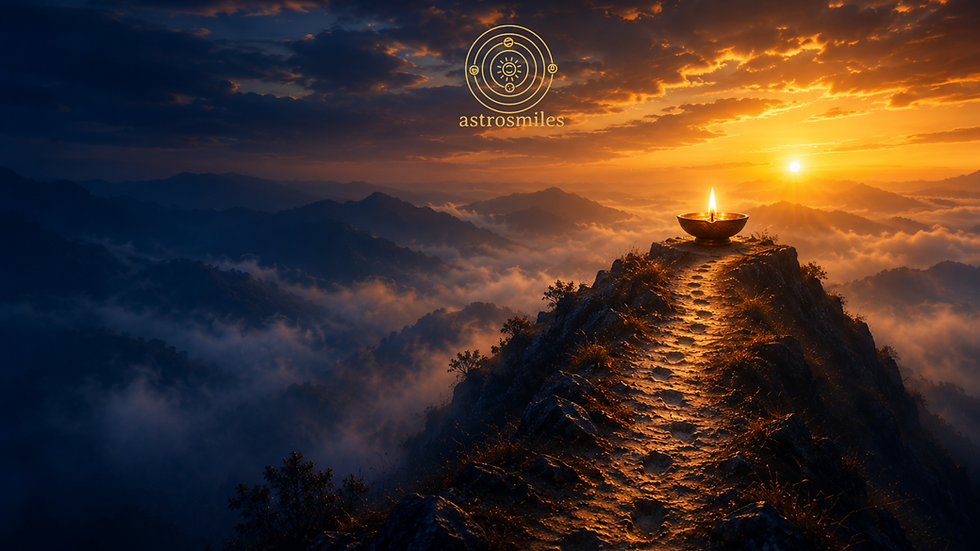
Of all the days we set aside to honour something, Guru Purnima may be the most quietly remarkable. It is not built around a deity. No god sits at its centre, waiting to be praised. On this full-moon night of Ashadha, what we honour instead is a person — whoever it was that removed a little of your darkness and handed you back the world with more light in it than it had before. A teacher. A grandmother. A stranger who said one right thing at the right moment and changed the direction you were walking.
This idea is quietly one of the most radical in the whole tradition. An observance thousands of years old, tied to the full moon — and its object of reverence is not the divine above but the human beside you who taught you something true. Guru Purnima tells you, without apology, that gratitude to another person is itself a sacred act. No temple required. Only memory, and the honesty to admit how much of what you know, you were given.
The Meaning Behind the Word
The power of the day is hidden inside the word itself. Gu means darkness. Ru means the one who removes it. A guru, in the oldest sense, was never merely someone who transferred information from one head to another. A guru was someone who changed what you could see — who took you from not-knowing to knowing, and in doing so, altered you permanently. That is a far higher bar than the word "teacher" usually carries, and a far wider one. It does not require a classroom, a title, or a fee. It requires only that someone genuinely moved you out of your own darkness.
This means most of us have had gurus we never once called by that name.
The Stories Behind the Day
Guru Purnima is also called Vyasa Purnima, after Maharishi Ved Vyasa — the sage who compiled the four Vedas out of a vast oral tradition and composed the Mahabharata. What is worth noticing is how Vyasa is remembered. Not as a god, but as a guru: the one who did the patient, unglamorous work of making wisdom transmissible — of taking what was scattered across generations of memory and shaping it so it could be handed forward, intact, to people he would never meet. That is the entire point of the day. We honour not the ones who merely possess wisdom, but the ones who take the trouble to pass it on.
In the yogic tradition, this is also the day Shiva first turned to teach. Having sat in silence beyond reckoning, the great ascetic finally faced the Saptarishis, the seven sages who had waited on him, and made his first transmission of yoga — becoming Adi Guru, the first teacher. It is a striking image: the recluse of the mountains, the one who had renounced everything, is also the origin of all teaching. His long stillness was not withdrawal from the world. It was the depth from which he finally had something worth giving.
Why We Bow to the Feet
The way the day is traditionally observed is stranger still, and it is worth understanding rather than dismissing. The disciple performs Padya Puja — the worship of the guru's feet. To a modern eye, this can look uncomfortable, even servile. But the feet are chosen for a precise and beautiful reason. They are the part of the guru that walked the path first — that went ahead into the difficult country, found the road, and then turned around and came back to show you where to place your own steps.
So you are not bowing to the person. You are bowing to the road they walked before you, so that you would not have to walk it blind. Every teacher you have ever had went somewhere hard ahead of you and returned with a map. That is what the feet mean. That is what the gesture is for — not submission, but acknowledgement of a debt: you went first, and you came back for me.
A Day for Naming Them
You do not need a shrine or a ceremony this Guru Purnima. You need only to do the one thing the day actually asks of you: remember. Remember the ones who walked ahead of you into something hard and came back with a way through. The teacher who saw something in you before you could see it yourself. The parent who taught you by living it. The mentor, the friend, the guide who handed you a little more light than you had. Name them, even if only to yourself. And where you can — before this moon sets — tell one of them that you know what it cost.
To Our Fellow Travellers
Guru Purnima is, above all, a day of the path — of the ones who walk it, and the ones who walk it together.
To everyone beginning their wellness journey with us on this full moon: welcome. There is no more fitting day to take a first step than the one the tradition set aside for exactly this — for placing your foot on a road someone has walked before you and lit the way through. We are glad you are here, and we do not take the trust lightly.
And to those already walking with us — our fellow passengers of many months, years, and many miles — thank you. A path is only ever as alive as the people on it, and you are what makes this one worth walking. We are grateful to be travelling alongside you.
Because that is the last, quiet truth of Guru Purnima: the guru and the disciple are not two fixed roles. We are all, always, a little of both — learning from those ahead of us, lighting the way for those behind. The light only ever moves by being passed on.
The teacher has spoken. In the days ahead, Sawan begins — the month of practice, of walking the map we were given. We will walk it with you.
If this speaks to you, the recent piece on the Tripundra — Three Lines of Ash follows the same teacher into what he understood about time, impermanence, and how to live because of it.
And if these words gave you a little light today, pass them on — share this with someone who would want it too, and leave a heart if it moved you. The light only grows by being handed forward.
To begin your own journey, or to book a personal consultation, write to amit@astrosmiles.com or WhatsApp +65 8727 7684.
The light only grows by being passed on. Happy Guru Purnima.


Comments