
Nothing on the Mountain Is Perfect

Updated: Aug 8
What Shiva's imperfect household knows about your flaws, your fears, and your chart.
There is a picture that hangs in a million homes, and you have seen it even if you think you haven't.
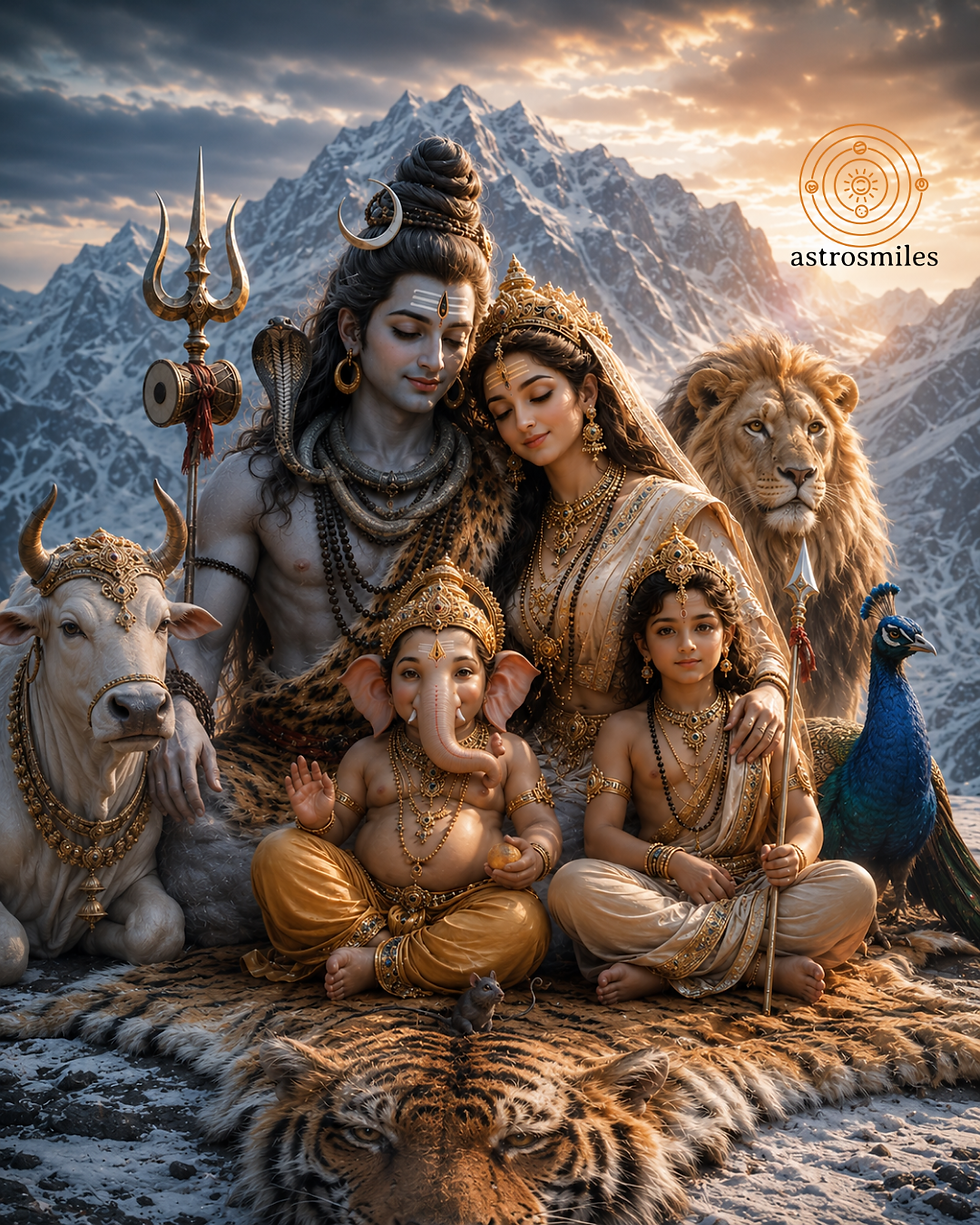
The calendar-art family portrait: a snow mountain, a tiger skin spread like a carpet, and four figures arranged in the easy geometry of people who belong to each other. Shiva, ash-pale, half-smiling. Parvati beside him, golden and unhurried. Ganesha at their feet, round and content. Kartikeya, young and bright-eyed, spear in hand. A family so familiar we have stopped actually looking at it.
So look at it. Properly, this time.
Start with the animals, because the animals give the game away. At Shiva's side kneels Nandi, the white bull. Around Shiva's neck coils a living snake. Under Ganesha sits his mount — a mouse. Beside Kartikeya stands his peacock. And behind Parvati waits her lion.
Now count the food chain. The snake, given one honest minute, would eat the mouse. The peacock, given the same minute, would eat the snake. The lion regards the bull the way you regard a menu. Every predator in that portrait is seated within striking distance of its prey — and has been, in painting after painting, for a thousand years.
Nothing eats anything.
That is not sloppy zoology. That is the entire teaching, hiding in plain sight on your grandmother's wall. And it goes deeper than the animals — because now look at the figures themselves.
A god with an elephant's head stitched onto a boy's body, one tusk broken off. A boy who was born in six pieces. A goddess whose scriptures remember her by a name that means she once refused herself even leaves. And the head of this household: an outsider smeared in cremation ash, with poison lodged permanently in his throat.
This is the family the tradition calls ideal — the adarsh parivar. Not one member of it is whole in the way the world counts wholeness. Every single one of them is, by ordinary standards, imperfect, rejected, patched, or scarred.
And every single one of them rules a realm.
That is the riddle this piece wants to sit with: how the most visibly imperfect family in creation became the most functional — and what that says about the flaws you have been trying to hide, outrun, or surgically remove from your own story.
The poison he never swallowed

Begin with the father, because his imperfection is the one he wears at his throat.
When the gods and demons churned the ocean for nectar, the first thing that surfaced was not nectar. It was halahala — a poison potent enough to end all the worlds. Everyone fled. And the universe did what it always does with what it cannot handle: it went looking for Shiva.
Notice what Shiva did not do. He did not neutralise the poison; even he could not unmake it. He did not swallow it, which would have destroyed him from within. He did not spit it out, which would have destroyed everything else. He drank it — and held it in his throat. Forever. The throat turned blue, and the tradition gave him its most tender name for it: Neelakantha, the blue-throated one.
Sit with that. The god of gods carries, permanently and visibly, a problem he did not cause and cannot fix. His mastery is not the mastery of solving. It is the mastery of holding — keeping the unfixable exactly where it can do no harm, neither denied nor obeyed.
This is the same figure, remember, whom respectable society rejected outright. Daksha, the prestigious father-in-law, looked at the ash-smeared, snake-wearing, cremation-ground-wandering Shiva and refused to even invite him to the family function. I wrote about that ash in Three Lines of Ash — the mark of a being who keeps the end of everything on his forehead. The one the world called unpresentable is the one the world runs to when the poison surfaces.
And his mount? Nandi — a bull. The most powerful animal in the portrait, doing the least. All that strength, seated. Waiting at the door of every Shiva temple, facing his lord, in no hurry at all. Strength that does not need to perform is the first lesson of the mountain.
The girl who was told she wasn't enough

Parvati's imperfection is the oldest one there is: she was, by every external measure, not qualified.
A mountain king's daughter, in love with an ascetic who had closed his eyes to the universe. When the gods tried the shortcut — sending Kamadeva, desire itself, to shoot Shiva into noticing her — Shiva opened his third eye and burned desire to ash. The shortcut did not merely fail. It was incinerated.
So Parvati did the one thing left. She stopped trying to be chosen and started to practise. She went to the mountains and performed tapas that frightened the seasons: standing through summer fires and winter rivers, eating only fallen leaves — and then giving up even those. The tradition remembers this in her name Aparna: she who did not eat even a leaf. The Skanda Purana says the first bilva tree rose from the sweat of these very austerities — a story I told in Three Leaves, One Stem. Read that again slowly: her effort itself became a tree. The tree became the offering Shiva loves above all others.
She did not win Shiva by becoming prettier, richer, or better connected — every door the world says is the door. She won by effort so total it became indistinguishable from the goal. The rejected girl became Annapurna, the goddess of nourishment — the one before whom, in the famous image, Shiva himself stands holding out a begging bowl. The one who was refused now feeds the refuser. The one who starved now feeds the world.
And she rides a lion. Not a tame creature — a predator, the very shape of the rage and ferocity a rejected woman is entitled to. She did not kill that ferocity. She did not pretend it wasn't there. She saddled it. On the battlefield, as Durga, it carries her. At home, it sits behind her, purring. The anger is not gone; it is employed.
The boy who was repaired

Ganesha is the only god in any pantheon I know of whose body is openly, visibly, a repair job.
You know the story — beheaded at the door of his mother's house for doing exactly what his mother asked, then revived with the head of an elephant because the original could not be restored. The tradition does not airbrush this. It paints the seam. Every image of Ganesha announces: this being's beginning went catastrophically wrong, and he was put back together with whatever love could find.
Then he broke further. When Vyasa needed a scribe for the Mahabharata, Ganesha agreed on the condition that the dictation never pause. Midway, his pen failed. And the god of wisdom did not stop to find a better pen. He snapped off his own tusk and kept writing. The world's longest epic was finished with a broken piece of its writer. That is why he is Ekadanta, the single-tusked — not a defect, a credential. Ask him what perfection is worth and he will point to the tusk: less than one finished manuscript.
And this patched, asymmetrical, pot-bellied god — whom does the tradition appoint as the remover of obstacles? Him. Vighnaharta. Every venture, every wedding, every new ledger in every shop opens with his name — first, before all the flawless gods. Think about why. You do not send a person who has never known breakage to clear the road. You send the one who was broken at the threshold and made whole again. Obstacles obey him because he has been one.
His mount completes the joke, and the joke is on us: the largest head in heaven rides the smallest animal on the mountain — a mouse. The mouse is desire — the small, nibbling, restless wanting that gnaws through granaries in the dark. Ganesha does not exterminate it. He sits his enormous wisdom gently on top of it and lets it carry him. A desire ridden is a vehicle. A desire chased is a hole in the floor.
The boy who lost the race

Kartikeya's story begins with scatter. Born from a spark too fierce for anyone to carry — passed from fire to river to reeds — he was found as six infants, nursed by the six Krittika stars, and embraced into one child with six heads. Shanmukha, the six-faced. He was never, from the first hour, a single seamless thing. And this assembled boy became Deva Senapati — commander of the armies of heaven, the one who ended the tyranny of Tarakasura. The gods did not wait for him to grow into smoothness. His realm is focus itself: his weapon a spear with a single point, given by his mother — all his scattered selves gathered into one tip.
But it is his defeat, not his victories, that carries the deepest teaching.
A question arose on the mountain that every family, every office, every heaven knows: who comes first? Among all the gods, who would receive the first worship — the opening prayer before every prayer? A race was set to settle it: around the world three times, and the first one home takes the honour forever. The gods mounted their vehicles, and none was more certain than Kartikeya. His peacock — once the very demon he had defeated, transformed by his spear into his carrier, his conquered enemy now his wings — was the fastest thing in the sky. He flew. Oceans, continents, three times around, as fast as a god can fly.
Ganesha barely moved. He knew a mouse does not outrun a peacock. So he reached instead for his father's own teaching: that one's father and mother contain the whole world, and to walk around them is to walk around everything. He circled Shiva and Parvati three times, bowed, and claimed the race. The elders agreed. The contest for first place was won standing still — by the god with the broken tusk.
Kartikeya came home having flown farther and faster than anyone in creation — and found he had lost. The texts are honest about what happened next: he was hurt. He felt cheated, unseen, second. He left home and stood alone on a hilltop far to the south. Every family knows this moment; almost no scripture anywhere admits gods can feel it.
And then the part that undoes me every time. His parents did not summon him back. They followed him — to his hill, on his terms. And there they told him what the race had been hiding all along: the prize you flew around the world for was never out there. You are the prize. Everything we have was always yours. The boy who came second became the healer-god of that very hill, and millions climb it to this day, carrying their own defeats to the one god who understands them.
He gave the race everything, lost anyway, and learned his worth had never been riding on the result. If you have ever come second in a race you emptied yourself for, that consolation was composed for you.
Why nothing eats anything
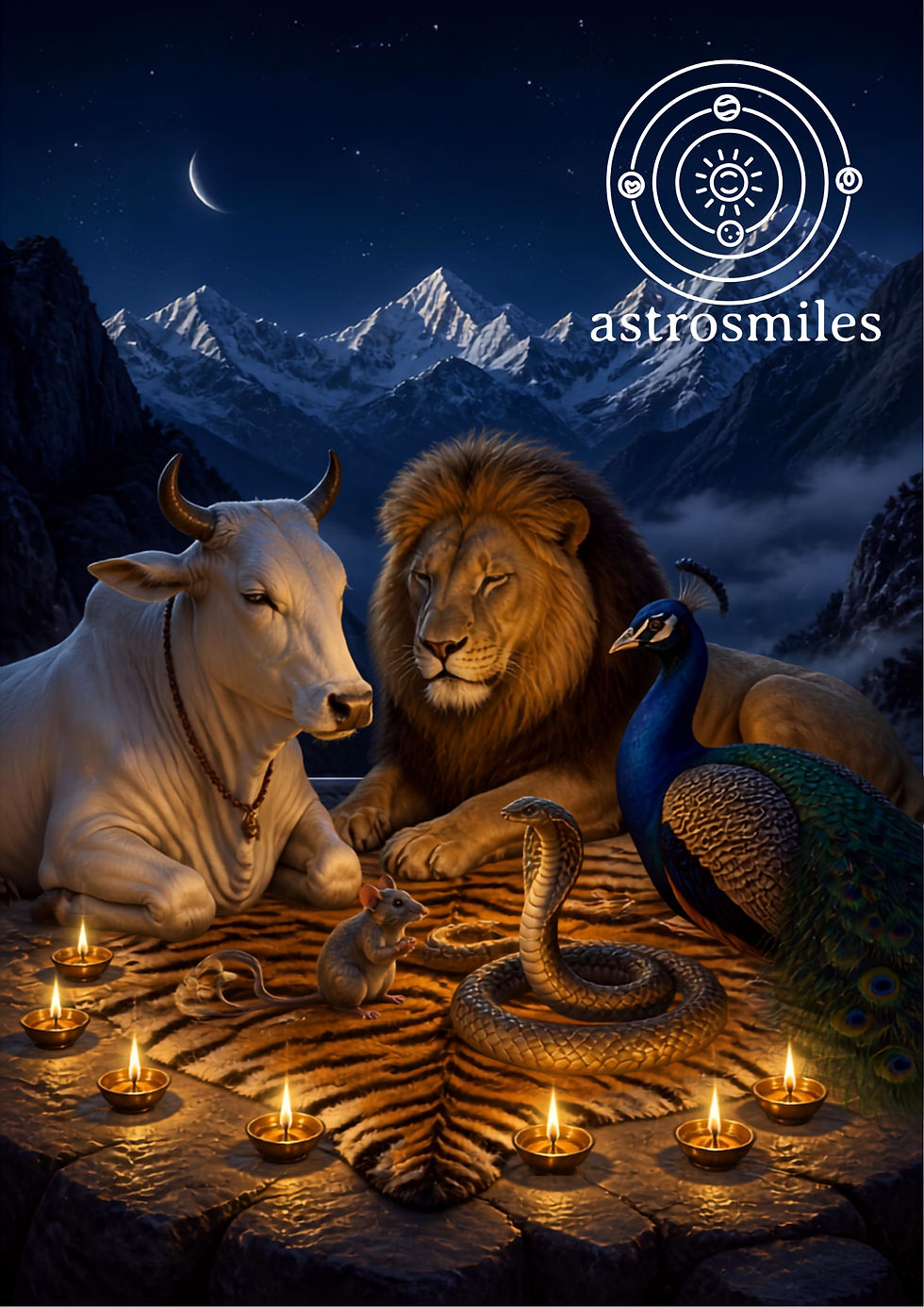
Now come back to the portrait, and the animals, because we can finally read it.
The snake has not stopped being a snake. The lion has not been declawed; the peacock has not forgotten what peacocks eat. On that mountain, every nature remains fully itself — poison, pride, hunger, fear, desire, ferocity — and nothing eats anything. Not because the natures were fixed, but because every one of them has been seated. Given a place, a master, a realm. The snake is worn, the lion is ridden, the mouse is a mount, the bull is a devotee. Held natures do not hunt.
That is the family's answer to the question we all carry into temples and consultation rooms: what do I do about the part of me that is wrong? The mountain answers: nothing on this peak was ever fixed. The poison is still in the throat. The tusk is still broken. The six heads are still six. The lost race stays lost. Liberation, this family insists, was never on the far side of your flaws. It is on this side — the moment each flaw is accepted, seated, and given honest work.
And notice what each of them controls, and what each of them surrenders. Shiva cannot unmake the poison — he controls only his hold on it. Parvati could not force Shiva's eyes open — she controlled only her practice. Ganesha could not un-break his beginning — he controlled the writing hand. Kartikeya could not rerun the race — he controlled the spear-point of his attention. In The Ink That Doesn't Wash Off I put it this way: some results are already declared, and the only ballot still in your hand is today's effort. The Bhagavad Gita teaches exactly what the race teaches — give your work everything you have, and let go of the result, because the result was never yours to hold. And when the result escapes you anyway — when you fly around the world and still come second — the tradition has kept a consolation waiting on a hilltop: the prize was you all along.
The fear of rejection is only ever the fear that our imperfection will be seen. This family's answer is to be seen first, entirely, and rule anyway. Ash-smeared. Single-tusked. Six-headed. Once refused. Framed in gold, on a million walls.
Your chart is that portrait

Here is where Jyotish enters, and it enters gently.
The nine grahas are not colleagues. The classical texts keep a frank register of their relations — graha maitri — and it reads like a family in a joint household: the Sun and Saturn, father and son, do not speak. Mars and Mercury grate. Rahu and the luminaries have history. Nine natures, several of them natural enemies, and at the hour of your birth all nine were seated together in one sky, in twelve rooms, whether they liked their neighbours or not.
Your birth chart, in other words, is not a report card. It is a family portrait — your own Kailash household, predators and prey seated together. There has never been a perfect chart. Not once, in the entire history of the science. Every chart ever cast carries its afflicted planet, its harsh aspect, its debilitation — its poison in the throat, its broken tusk, its lost race.
The family even signs its members onto the sky. Kartikeya is the presiding deity of Mars — which is why the classical remedy for a harsh Mangal has always been his worship: not the removal of the fire, the commissioning of it. A difficult Mars given a realm — sport, surgery, service, struggle for others — is not a dosha; it is a Senapati. Ketu, the headless graha of severance and strange beginnings, answers to Ganesha — who else, than the god whose own head was severed and strangely replaced? And on Shiva's matted hair sits the crescent Moon — the mind itself, worn as an ornament by the one being who learned to hold what he could not fix.
So when an astrologer tells you Saturn sits heavy in your chart, or Mars burns in the wrong house, hear it the way the mountain would: not this part of you must be eliminated — it cannot be, any more than the halahala could — but this animal has not yet been seated. The whole craft of remedy, honestly practised, is the craft of turning predators into mounts.
Come meet your household
If this found something in you, share it with someone who is trying to become perfect before they let themselves be seen.
And if you would like to meet your own Kailash household — the nine natures your sky seated together at the hour you were born, which of your animals are already mounts and which are still loose in the house — a 30-minute birth chart consultation is where that begins. Write to us at amit@astrosmiles.com or WhatsApp +65 8727 7684. Being Hanuman and Dial 108 are available in the AstroSmiles Shop.
The ash taught us what burns. The leaf taught us what must stay whole. The ink taught us that every effort is counted.
The family teaches the last thing: that nothing on the mountain is perfect, and everything on the mountain is at peace — and that these two facts, seated side by side like a snake and a mouse, are not enemies at all.
The imperfection is not in the way of the realm.
The imperfection is the realm.


Comments